sabato 25 maggio 2013

Etty Hillesum, impressioni


Ho letto il diario di Etty e adesso sto cercando di ampliare la mia conoscenza sul suo pensiero e la sua vita leggendo saggi o libri scritti su di lei. Sono molto impressionata dalla presa di coscienza di questa ragazza, che dapprima si dipinge come un pò frivola, incerta riguardo i propri desideri ed aspirazioni e poi, nel corso del diario e due anni e qualche mese di vita documentata nel suo diario, donna che ha ben chiara la sua vocazione: scrivere, essere la cronista del suo tempo e, in maniera più ampia, essere amante dell'umanità.
"Una volta vivevo sempre come in una fase preparatoria, avevo la sensazione che ogni cosa che facevo non fosse ancora quella 'vera'. Ora questo sentimento è cessato. Io vivo, vivo pienamente e la vita vale la pena viverla ora, in questo momento; e se sapessi di dover morire domani direi: mi dispiace molto, ma così è stato, è stato un bene."

Non le sono risparmiate cadute ed errori, anche enormi, ma che non sta al lettore giudicare. Però è proprio questa doppia sfacettatura di umanità, profonda ma al tempo stesso fragile, che la rende così cara.
Stupisce anche che la miccia sia stata innescata da un uomo, Julius Spier, che entra nella sua vita prima come suo chiroterapeuta (o qualcosa di simile) e poi come amico e per certi versi amante. Etty non nega l'attrazione fisica per lui, ma è paradossalmente attraverso Spier che lei capisce di non essere fatta per l'amore di un solo uomo, e, da quel che capisco io, la conclusione che lei trae prima della morte di lui è quella del celibato. Proprio lei che ha avuto spesso un atteggiamento sessualmente molto libero.
"Nasce tutto d’un tratto in me, come una certezza sempre più chiara: io non mi sposerò mai. Non voglio spezzettare in una moltitudine di piccoli appagamenti un grande Desiderio."

Il diario pur narrando una storia che va incontro ad un epilogo drammatico, è un inno alla gioia del vivere, al vivere l'istante, vivere la sofferenza e accoglierla, così che questa si possa addormentare come un bambino (come dice W. Rathenau), incominciare ogni giorno.


I have read the diary of Etty and I'm now trying get deeper with my knowledge on her thinking and life reading essays or books written about her. I am very impressed by the growing awareness of this girl, who at first portrays itself as a bit frivolous, uncertain about her desires and aspirations, and then, in the course of the diary and two years and a few months of life documented in her diary, woman who has clear vision on her vocation: to write, to be the chronicler of his time and, more broadly, to be a lover of humanity.
"I used to live always as in a preparatory stage, I felt that everything I did was not yet the 'real' one. Now this feeling has ceased. I live, I live fully and life is worth living it now, at this moment, and if I knew I would die tomorrow I would say: I am very sorry, as it was, it was good. "
She's not spared with falls and mistakes, even huge ones, but that is not for the reader to judge. But it is precisely this "double sided-humanity", deep but fragile at the same time, that makes her so attractive.
It is surprising also that the fuse has been triggered by a man, Julius Spier, who comes into his life as his first chiropractor (or something similar) and then as a friend and in some ways lover. Etty does not deny the physical attraction to him, but it is paradoxically through Spier that she understands not to be created for the love of one man, and finally she draws the conclusion (or at least this is what I think about this), before his death, of celibacy. She who has had an attitude often very sexually-free.
"It comes all of a sudden in me, with a certainity increasingly clear: I will never marry. I don't want to break up into a multitude of small satisfactions a great Desire."
The diary, while telling a story that undergoes a dramatic epilogue, is a hymn to the joy of life, to living the moment, living the suffering and accept it, so that sorrow can sleep like a baby (as
W. Rathenau says). Begin each day.


mercoledì 3 aprile 2013

Great little tools: Google Session Manager

I'm working in my thesis lately and I found myself more than once in having a dozen of tabs open in Chrome and...no more time/energy to go on with the work! So if you ever thought "man I'd love to have all of this ready on Chrome when I turn on the pc tomorrow- or after the weekend. or after the restart to complete the antivirus scan", this is the tool for you!
Go straight to https://chrome.google.com/webstore/detail/session-manager/bbcnbpafconjjigibnhbfmmgdbbkcjfi and that's about it in a few secs ;)
You can now save sessions of opened tabs and windows and fastly open them when you need it!


domenica 24 marzo 2013

Quick reflex/lenses care-taking trick

How many time has this happened to you?
A few times for me. And I'm giving the solution also the the issue you face when the lens is not working fine when focusing. Often the problem is simple: oxidation or dirt/dust on the contact. Also the key to resolve this kind of problem is at hand-reach.
The answer is: oil, preferably extra virgin. Natural anti-oxidant par-excellence!
Use a soft rag, and be careful that it's a  rag which won't leave behind pieces of paper/bits of itself. I personally use a google wipe and it works perfectly. Clean the contacs-area and if needed leave for a 10-20 minutes the wipe on the contacts to let the oil work. After that, clean up with paper(again not leaving bits) and try...no more Error 99 ;)

sabato 9 marzo 2013

Gitino breve in zona!


C'è un posto poco conosciuto vicino a Gorizia dal quale si gode di un panorama stupendo e inusuale. Raggiungerlo è semplice, si percorre la strada dal valico di Gabria (all'inizio del cosiddetto "vallone") entrando in Slovenia e seguendo le indicazioni per Miren. Dopo aver superato l'abitato di Miren si affronta qualche tornante finchè sulla sinistra compare un parcheggio con grande spiazzo annesso. Lasciate qui la macchina e seguite la strada sterrata che nel suo versante sud-orientale con giornate serene, permette di vedere fino al mare, il Golfo di Trieste. La strada vi porterà in una quarantina di minuti sulla sommità della collina Faiti, offrendo dei pannelli sulla storia dei luoghi percorsi. Sulla sommità si trova il "gigante incompiuto", il monumento ai difensori della terra slovena. Io c'ero già stata la primavera scorsa, ma la neve e il poco tempo a disposizione in una giornata di sole fantastico mi hanno richiamata a questo angolino panoramico e molto suggestivo nel candore della neve. Vari sono i sentieri percorribili che si snodano sulle propaggini di queste colline tra cui i “Sentieri di pace sul Carso-Poti miru na Krasu”.


martedì 5 febbraio 2013

Schladming 2013, pronti(?)...via!

Proprio mentre a Schladming le atlete sono bloccate al cancelletto di partenza, causa nebbia intensa, dopo le copiose nevicate dei giorni scorsi, e dopo esser tornata io stessa ai miei adorati sci dopo 14 mesi di fisioterapisti/operazione/creme/massaggi/esercizi/fatica, vi scrivo di questi mondiali di sci alpino. Nel cuore della stagione di Coppa del Mondo ecco l'evento più atteso. Seguirli è semplice, raisport1, oltre ad altre emittenti private, osserva in diretta le gare. Il calendario con gli atleti azzurri al via:
 MARTEDI' 5 FEBBRAIO: SuperG donne (ore 11). Italia: Merighetti, E. Curtoni, N. Fanchini, Goggia.
  • MERCOLEDI’ 6 FEBBRAIO: SuperG maschile (ore 11). Italia: Innerhofer, Heel, Marsaglia, Fill, Klotz.
  • VENERDI’ 8 FEBBRAIO: Supercombinata donne (discesa ore 10, slalom 14). Italia: Merighetti, E. Curtoni, Goggia, E. Fanchini.
  • SABATO 9 FEBBRAIO: Discesa maschile (ore 11). Italia: Paris, Innerhofer, Heel, Fill.
  • DOMENICA 10 FEBBRAIO: Discesa donne (ore 11). Italia: Merighetti, E. Curtoni, E. Fanchini, Goggia.
  • LUNEDI’ 11 FEBBRAIO: Supercombinata uomini (discesa ore 12, slalom 18.15). Italia: Fill, Innerhofer, Klotz, Paris.
  • MARTEDI’ 12 FEBBRAIO: Team Event (ore 17). Italia: Deville, M. Moelgg, Simoncelli; Costazza, E. e I. Curtoni.
  • GIOVEDI’ 14 FEBBRAIO: Gigante donne (ore 10/13.30). Italia: I. Curtoni, Karbon, Moelgg, Azzola.
  • VENERDI’ 15 FEBBRAIO: Gigante maschile (ore 10.30). Italia: Blardone, Simoncelli, Moelgg, Marsaglia.
  • SABATO 16 FEBBRAIO: Slalom donne (ore 10/13.30). Italia I. Curtoni, Costazza, Azzola, Moelgg.
  • DOMENICA 17 FEBBRAIO: Slalom maschile (ore 10/13.30). Italia: Gross, Moelgg, Razzoli, Thaler.
  •  
    Grandi le attese e speranze soprattutto per gli atleti di casa che in questo tratto di Coppa stanno facendo vedere belle cose: le sorelle Curtoni, un Christof Innerhofer imprevedibile ma già vincente, Simoncelli che ha dimostrato il suo valore con un grande rientro dopo il grave infortunio di questa estate, Domme (Paris) che ha recentissimamente vinto la libera di Kitzbuhel, Deville, Manfred Moellg (7o e migliore degli italiani nella classifica generale) e Gross. Debutto per la bergamasca Goggia in supercombi e discesa. Dunque aspettiamoci grandi cose e tifiamo azzurro. Per contro i mostri sacri pronti a dar battaglia: Hirscher, Svindall, Neureuther e Ligety per gli uomini e Maze, Riesch, Vonn (con una stagione che la sta vedendo in un alternarsi di grandi exploit e momenti difficili), Fenninger, Zettel, Shiffrin (l'americana rivelazione dell'anno), Rebensburg e Mancuso. Incognite pericolose Laretta (Gut) e Lizzie (Goergl).
    Buon divertimento!


    lunedì 3 dicembre 2012

    Presciistica!

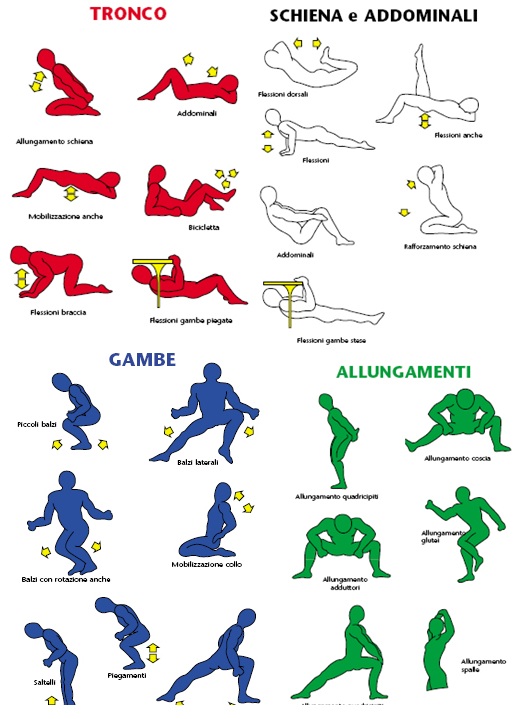
    Con un lieve ritardo su quello che potrebbe essere il piano per l'appassionato di sci medio o frequentatori domenicali degli impianti vorrei proporre uno schema di esercizi di presciistica per giungere pronti sugli sci, non come ho fatto io l'altro anno, spaccandomi.
    Un buon programma potrebbe essere eseguito seguendo il seguente:


    Riscaldamento: 10′ di cyclette o corsa blanda
    Alternare 1’ di corsa lenta ad 1’ di corsa veloce. Ripetere 4 volte
    Affondi frontali: 10-15 ripetizioni per gamba per 3 volte
    Affondi laterali: 10-15 ripetizioni per gamba per 3 volte
    Squat senza pesi: 10-15 ripetizioni per 3 volte
    Addominali: 20 ripetizioni per 3 volte di crunch classico
    Esercizi di mobilità articolare: 30 secondi di circonduzione del collo e braccia (avanti e dietro)
    Torsioni del busto 20 a destra e 20 a sinistra.

    Importante è che eseguendo gli esercizi, i muscoli siano un minimo scaldati e il lavoro venga fatto seguendo scrupolosamente le posizioni indicate per evitare di sovraccaricare vari punti della schiena per compensare la mancanza di tono muscolare. esercizi alternativi per scaldarsi potrebbero essere: in posizione eretta, gambe leggermente divaricate, braccia lungo i fianchi. Solleva in modo alternato il tallone destro e poi quello sinistro, abbinando il movimento dei piedi con rotazioni in avanti delle braccia, così per un minuto, poi un minuto ruotando le braccia indietro.
    In posizione eretta, fletti leggermente le ginocchia , gambe e piedi uniti.
    Appoggia le mani sulle cosce con i pollici rivolti verso l'interno, con busto sempre dritto e le spalle ben aperte disegna con le ginocchia 20 cerchi verso destra e venti verso sinistra senza fermarti.
    Ricordate che per essere pronti non basta avere i muscoli tonici, anche il cuore deve pompare bene, per cui ,prima di eseguire gli esercizi o a giorni alterni, suggerisco di andare a correre almeno una ventina di minuti con poi qualche minuto di stretching. Questo renderà gradualmente funzionante in maniera ottimale il trasporto dell'ossigeno nei muscoli.
    Per rendere la preparazione alla stagione più varia e piacevole io trovo simpatico impiegare una sorta di cuscino gonfiabile, per l'allenamento propriocettivo e di resistenza dei muscoli degli arti inferiori. Ugualmente valido può verificarsi l'uso dei palloni da ginnastica:
    Gli allenamenti dovrebbero durare un'oretta circa, meno se non includete la corsa, con cadenza bisettimanale. 
    Alcuni esercizi che potete utilizzare:


    giovedì 22 novembre 2012

    Talking about Yashica 44

    I have this camera since two years now, month more or less, and it's given me joy and sadness both. Let's clarify that that sadness came for my bad, cause I somehow made an error during the loading of the film. This camera was a gift to my grandad from one of his brothers and, I'm not sure, but I don't think it was uesed much. The first film I used was bought in Venice in a nice little shop, the other two on the internet. It uses a 127 mm film, black&white and it's great for both street photography and architecture photography. At this link you can have a look at the manual: http://www.butkus.org/chinon/yashica/yashica_lm_44/yashica_lm_44.htm

    Yashica 44, 44A, and 44LM were a series of small twin-lens reflex cameras, they give 12 exposures of 4x4 cm. The 44 model was first introduced in Japan in 1958 and it was surely inspired by the gray Baby Rolleiflex of 1957. The Yashica 44 featured crank film advance, with automatic frame spacing after the user aligned the number "1" in a red window. However a separate lever cocked the shutter, and there was no interlock to prevent double-exposures. The Copal SV shutter offered speeds from 1 to 1/500 seconds plus B in the standard geometric sequence; and the lens was a 3-element Yashikor 60mm f/3.5. (from camerapedia).


    I've been very happy with the one film I took last year and I'm about to finish another one. This camera is great to work on multiple exposures! The other interesting thing is the POV of the pics, it's naturally "alienated" beacause of the twin-lens and because you don't shoot at eye-level but below.

    venerdì 16 novembre 2012

    Le regine dell'autunno: le castagne


    Mai pensato, passando accanto ai baracchini che in questo periodo dell'anno popolano i viali dei nostri centro città, di voler avere questi profumatissmi e deliziosi frutti della terra pronti a casa vostra? Magari da accompagnare con un buon bicchiere di ribolla o del vino nuovo? Oltre ai metodi più tradizionali con le pentole bucate o sullo "spargher" ( come si usa dalle mie parti per preparare ribuele e cjastinis)  o semplicemente lessandole, è possibile cucinare le castagne anche in forno. Basterà mettere a mollo in acqua dopo averne lavato la buccia esterna, per un paio d'ore. Poi vanno scolate e incise da entrambi i lati per permettere la cottura ottimale e agevolare la sbucciatura una volta pronte. Trascorso il paio d'ore, in forno pre-riscaldato a circa 200 gradi per minimo una ventina di minuti...a piacere. Dopodichè il tempo di raffreddarsi quel pò che basta a non ustionarsi e potrete gustarle al caldo della vostra casa ;)


    venerdì 2 novembre 2012

    bicicleggiando

    Percorso: Ciclabile Bolzano-Merano (Ciclabile dell’Adige, in parte lungo la Via Claudia Augusta)
    Tempo di percorrenza: ca. 1,5 - 2 ore
    
Lunghezza del percorso: ca. 30 km
    Dislivello: 75 m sull’intero percorso
    Tipo di terreno: strada asfaltata lungo il fiume
    Possibilità di accesso alla ciclabile: da Bolzano, Appiano, Terlano, Andriano, Nalles, Vilpiano, Gargazzone, Lana e Postal
    Treno & Bici: i treni regionali che offrono il servizio Treno & Bici circolano sulla linea ferroviaria parallela alla pista ciclabile (Bolzano-Merano) i giorni lavorativi ogni 30 minuti.

    Tra gli innumerevoli tratti di ciclabile del Trentino Alto Adige questo è un dei più semplici, essendo quasi interamente in piano e quando sono a Bolzano mi piace percorrerlo, magari non tutto, arrivando ogni volta in un paese diverso. In tutti i paesini prima di Merano si trovano bar/analoghi dove fare sfiziose merende ;)
    Io prendo la ciclabile dal lungo Talvera dopo il lido. Dopodichè allontanandosi dalla città si raggiunge un incrocio verso Appiano e Merano. Qui c'è un spazio dove sostare e c'è una fontana ed una carta geografica con le piste ciclabile della zona. Si svolta a destra e si prosegue verso nord, costeggiando frutteti, per lo più meleti. Dopo un piccolo passaggio a livello ed una curva a sinistra ci si trova sulla strada in direzione Frangarto, frazione di Appiano. Dopo un ulteriore passaggio a livello si curva a destra per imboccare la ciclabile. Da qui si è accompagnati a destra dalla ferrovia e a sinistra dal fiume e la strada per giungere a Merano è praticamente rettilinea.


    domenica 14 ottobre 2012

    Insonnia...brutto nemico

    Negli ultimi decenni molti fattori han fatto sì che i disturbi legati al sonno, e al sistema nervoso centrale più in generale, sono diventati molto presenti nella popolazione più, cosiddetta, economicamente avanzata.
    Ora per vicende mie e per i miei studi, l'argomento mi è piuttosto familiare e quindi mi sembra di consigliare qualcosa, con l'assoluta consapevolezza di non essere un'esperta e men che meno un medico.


    Detto questo per prima cosa, essenziale alla salute "della testa", sono convinta, rimane quella del corpo. Insomma "mens sana in corpore sano".  Quindi, regola d'oro n. 1 se c'è il tempo e la possibilità ritagliatevi dei momenti per fare un qualche tipo di attività fisica, in maniera costante durante la settimana. Sarebbe meglio non fosse la sera se si hanno già problemi di sonno abbastanza consistenti, perchè sì le endorfine liberate fanno bene e il fisico ne ha giovamento, però l'effetto "collaterale" è l'attivazione del sistema nervoso centrale, quindi una maggiore reattività generale.
    Secondo prezioso consiglio: trattatevi bene. Ossia cercate di essere abbastanza regolari con gli orari e l'alimentazione dovrebbe essere quanto più equilibrata evitando ad esempio troppi carboidrati e pasti eccessivi la sera (eccetera eccetera eccetera). Inoltre date tempo a voi stessi, a quello che vi da tranquillità.
    Comunque immaginatevi come un catino che per gli stress della vita quotidiana, stanchezza e chi vuole aggiunga, pian piano si riempe. A volte può strabordare e allora diventa faticoso svuotarlo a livelli accettabili e le conseguenze dell'inondazione potrebbero non essere banali. Il trucco è ovviamente mantenere il livello d'acqua basso e costante e gli strumenti più immediati sono quelli appena citati.
    Le endorfine sono un gruppo di sostanze prodotte dal cervello nel lobo anteriore dell'Ipofisi, classificabili come neurotrasmettitori, dotate di proprietà analgesiche e fisiologiche simili a quelle della morfina e dell'oppio, ma con portata più ampia.


    Sezione "rimedi della nonna":


    senza ricorrere all'artiglieria pesante, per così dire, ci sono molti prodotti a disposizione che possono migliorare la qualità e la quantità del sonno. Si parte dalla classica camomilla (attenzione a non lasciare troppo in infusione altrimenti si rischia l'effetto opposto) usando il fiore intero, prima di andare a dormire, alle tisane miste di melissa, passiflora e altre piante di uso comune e riconosciuto soprattutto nell'area austriaca e tedesca, ai preparati di libera vendita a base di valeriana, ai preparati combinati di melatonina/triptofano/vitamine del gruppo B, per giungere alle tecniche di training autogeno/rilassamento/yoga&Co. . Di parte di questi rimedi è anche riconosciuta scientificamente l'efficacia ma è ovvio che a determinato problema ci sarà adeguato strumento. Se il problema dovesse uscire dal vostro controllo, rivolgetevi a qualcuno di certamente competente e di cui potete in qualche modo fidarvi. La cosa importante è non lasciare che si instauri alcun circolo vizioso che allarghi, cerchio per cerchio, il problema. Il nostro corpo non finirà mai di stupirmi, in primis porprio questa strana noce (passatemi il termine) che è il cervello.
    Sorprendente come possiamo essere delle macchine, geni, grandi e fini menti ma come al tempo stesso possiamo essere fragili e delicati!


    lunedì 8 ottobre 2012

    IRELAND: V E FINAL CHAPTER

    Day 12, August 19th
    After a second night in Dundalk we went to Mellifont Abbey (http://www.mellifontabbey.ie/ this is the website of the monks themselves, they still are in the area, but in another building). It was the first Cistercian abbey to be built in Ireland in 1142 on the orders of Saint Malachy, Archbishop of Armagh, Mellifont Abbey sits on the banks of the River Mattock, some ten km (6 miles) north-west of Drogheda.
    By 1170, Mellifont had one hundred monks and three hundred lay brothers. The Abbey became the model for other Cistercian abbeys built in Ireland, with its formal style of architecture imported from the abbeys of the same order in France; it was the main abbey in Ireland until it was closed in 1539, when it became a fortified house. In 1603 the Treaty of Mellifont was agreed between the English Crown and Hugh O'Neill, Earl of Tyrone in the abbey grounds.
    William of Orange used Mellifont Abbey House as his headquarters during the Battle of the Boyne in 1690.
    Mellifont Abbey is now a ruin. Little of the original Abbey remains, save a 13th-century lavabo (where the monks washed their hands before eating), some Romanesque arches and a 14th-century chapter house.
    New Mellifont Abbey is home to the Cistercian Order in County Louth and is located in Collon, a small village and townland in the south west corner of County Louth, Ireland on the N2 national primary road.
    Nice little place!


    After that, we turned in Dublin direction, airport, to unwillingly get the car back at the rental place. Taxi to the apartment, our home for the last days in Ireland, near the Guinness storehouse. Got SO nasueated by the toasting smell!I didn't think I could be...
    The remaing part of the day we obviously dedicated to the Storehouse itself, really cool and interesting!
    Dinner at home with...Dr.Oekter pizza :P and after that we went to a hotel were they had songs and irish ballet going on.


    Trinity college
    Day 13, August 20th
    Journey trought ages.
    From the Dubh Linn gardens. A park not many people know about - hidden behind Dublin Castle, doubling as a helicopter landing site and rarely visited by tourists. But popular with the lunchtime crowd from the surrounding offices. The tower is the only visible (from outside) part of the medioeval castle.

    We booked online the night before, the free walking tour of Dublin with Sandemans. Eleanore guided us fisrtly in the city hall explaining the early history all the way to recent facts, then to the castle, Temple Bar where we had time to have a quick snack. After that O'Connell street, facts about Joyce, and the end at Stephen's Green, a public garden where there also a few  references to the Famine. In fact, it was almost paradoxical thinking that a few of us visiting wouldn't be there if it weren't for the famine and all the tragedy of it.


    St. Stephen's Green
    Part of the goup went on with Elelanor to have lunch, we rested a while in the park then we had a walk in the shopping lane to buy souvenirs and cards and meet...Molly Malone :)
    Molly Malone

    Home to rest a bit and then last night of craic out first at the Brazen Head (http://www.brazenhead.com/) oldest pub of Dublin and the to get a more "regular" session at the Cobblestone.
    Sweet dreams


    Day 14, August 21st
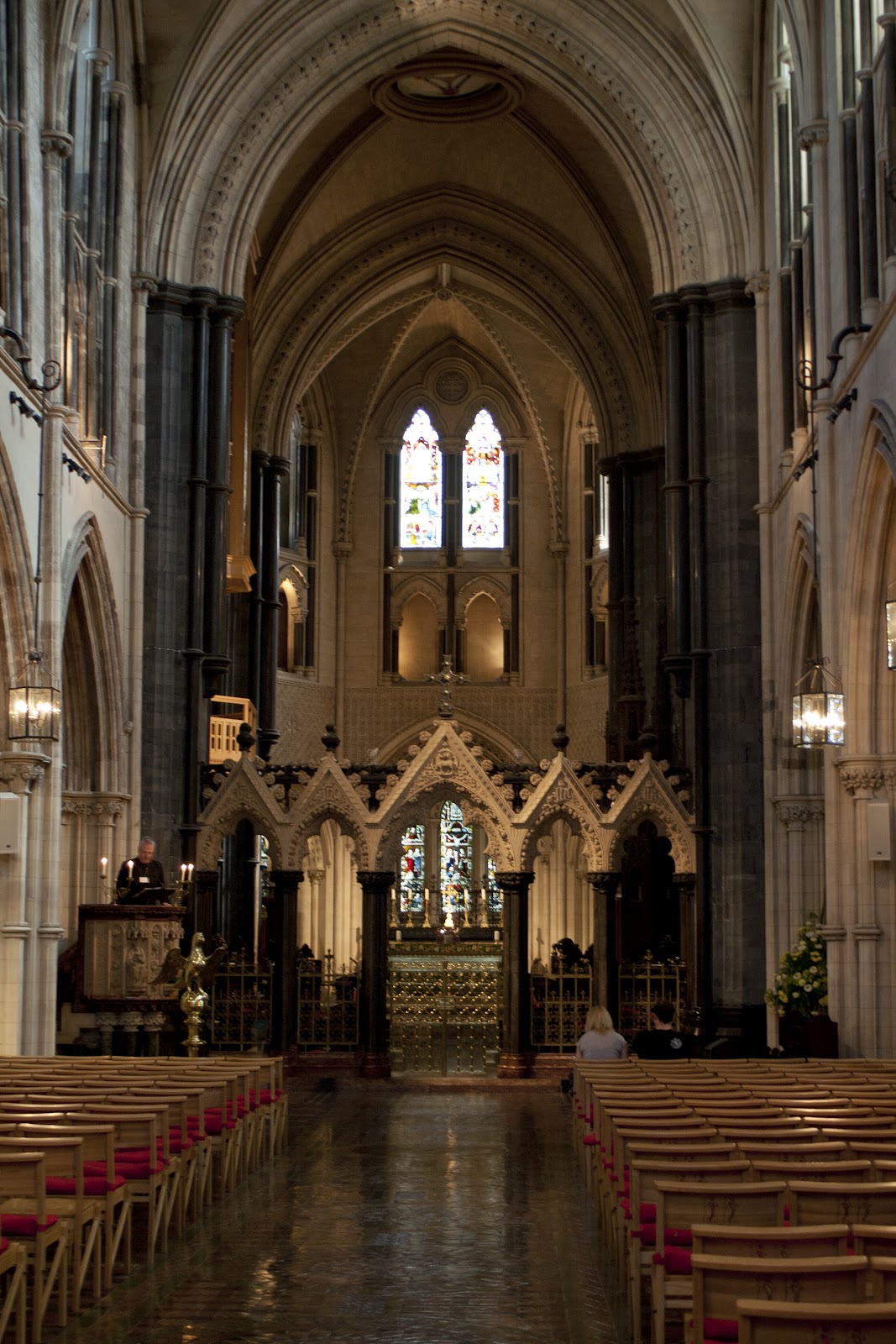
    Visited St. Audeon and Christ Church whic is the cathedral of the United Dioceses of Dublin and Glendalough and the cathedral of the Ecclesiastical province of the United Provinces of Dublin and Cashel in the Church of Ireland. Founded probably sometime after 1028 when King Sitric Silkenbeard, the Hiberno-Norse king of Dublin made a pilgrimage to Rome.
    In the 1180s, Strongbow and other Norman magnates helped to fund a complete rebuilding of Christ Church, initially a wooden building, in stone, comprising the construction of a choir, choir aisles and transepts, the crypt and chapels to St. Edmund and St. Mary and St. Lô.
    The cathedral was the location of the purported coronation, in 1487, of Lambert Simnel, a boy pretender who sought unsuccessfully to depose Henry VII of England, as "King Edward VI".
    In 1493, the choir school was founded. In 1539, King Henry VIII converted the priory to a cathedral with a dean and chapter and worked to ensure Christ Church adhered to his new church structure. His immediate successor, Edward VI of England, in 1547, provided funds for an increase in cathedral staffing and annual royal funding for the choir school.
    The cathedral was extensively renovated and rebuilt from 1871 to 1878 by George Edmund Street, with the sponsorship of distiller Henry Roe of Mount Anville.


    Christ Church also contains the largest cathedral crypt (63.4m long) in Britain or Ireland, constructed in 1172-1173. Having been renovated in the early 2000s, it is now open for visitors.
    The crypt contains various monuments and historical features, including:
    - the oldest known secular carvings in Ireland, two carved statues that until the late 18th century stood outside the Tholsel (Dublin's medieval city hall, which was demolished in 1806)
    - a tabernacle and set of candlesticks which were used when the cathedral last operated (for a very short time) under the "Roman rite", when the Roman Catholic king, James II, having fled England in 1690, came to Ireland to fight for his throne and attended High Mass in the temporary restoration of Christ Church as a Roman Catholic cathedral.
    - the stocks, formerly in Christ Church Place, made in 1670 and used for the punishment of offenders before the Court of the Dean's Liberty (the small area under the cathedral's exclusive civic authority), moved here in 1870
    - historic books and altar goods of the Cathedral
    - "The Cat & The Rat" are displayed with an explanatory note (and I will leave it as a surprise ;) )


    Costumes from the TV series "The Tudors"
    Then we walked to St.Patrick cathedral, ate in the adjacent park a delicious toast and the rain caught us for the last time and the first and last thunder announcing it.
    We visited the castle (http://www.dublincastle.ie/) to stay dry and by the time we were done the sun would have shined again =)
    St. Patrick's cathedral and storm coming
     The building actually is not very "castlely", it's more a palace. It was until 1922 the seat of British rule in Ireland, and is now a major Irish government complex. Most of it dates from the 18th century, though a castle has stood on the site since the days of King John, the first Lord of Ireland. The Castle served as the seat of English, then later British government of Ireland under the Lordship of Ireland (1171–1541), the Kingdom of Ireland (1541–1800), and the United Kingdom of Great Britain and Ireland (1800–1922). Upon establishment of the Irish Free State in 1922, the complex was ceremonially handed over to the newly formed Provisional Government led by Michael Collins.

    Originally built as a defensive fortification for the Norman city of Dublin, it later evolved into a royal residence, resided in by the Lord Lieutenant of Ireland or Viceroy of Ireland, the representative of the monarch. The second in command in the Dublin Castle administration, the Chief Secretary for Ireland, also had his offices there. Over the years parliament and law courts met at the castle before moving to new purpose-built venues. It also served as a military garrison. Upon formation of the Free State in 1922, the castle assumed for a decade the role of the Four Courts on the Liffey quays which had been badly damaged during the Civil War.
    It was decided in 1938 that the inauguration of the first President of Ireland, Douglas Hyde would take place in the castle, and the complex has been host to this ceremony ever since. The castle is also used for hosting official State visits as well as more informal foreign affairs engagements, State banquets, and Government policy launches, as well as acting as the central base for Ireland's hosting of the European Presidency approximately every 10 years.


    ;)
    Here you have a map of Dublin:


    Last night in Ireland, last absurd pizza and after few hours we were up 3.30 a.m. to take the same taxi we got arriving in Dublin, and on the plane with full eyes, mind and heart!
    I hope you got at least a tenth of what was this great holiday to us!


    venerdì 5 ottobre 2012

    Ireland: chapter IV

    Day 9, August 16th
    Here and there in Connemara and the Sky road.
    Starting from Galway we had an idea of Connemara. First we stopped in Coral Beach, what an amazing place. The sand was made by these little pieces of corals: white, red, orange. Sun was shining, only thing that kept us off the water was the really really strong wind!
     Then on the famous Sky Road, I suggest bike tours over there. Final visit of the day was at Kylemore Abbey and gardens (http://www.kylemoreabbey.com/).
    The mountainous valley around Kylemore is an area of old oakwoods which terrace the mountainside. As the story, and wikepedia, goes: Kylemore Castle was built as a private home for the family of Mitchell Henry, a wealthy doctor from London, whose family was in textile manufacturing from Manchester, England. He moved to Ireland, when he and his wife, Margaret, purchased the land around the Abbey and became a politician, and was also an MP for County Galway from 1871 to 1885. The castle was designed by James Franklin Fuller and Ussher Roberts. Construction first began in 1867, and took one hundred men four years to complete. The castle covered approximately 40,000 square feet (3,700 m2) with over 70 rooms and the principal wall was two to three feet thick. The facade measured 142 feet (43 m) in length and is made of granite brought from Dalkey by sea to Letterfrack and limestone from Ballinasloe. There were 33 bedrooms, 4 bathrooms, 4 sitting rooms, ballroom, billiard room, library, study, school room, smoking room, gun room and various offices and domestic staff residences for the butler, cook, housekeeper and other servants. Several other building including a Gothic cathedral and family mausoleum containing the bodies of Margaret Henry, Mitchell Henry and a great grand nephew.
    The Abbey remained in Henry's estate after he returned to England, and the castle was sold to the Duke and Duchess of Manchester in 1909, they resided there several years, before being forced to sell the house and grounds due to gambling debts. In 1920 the Irish Benedictine Nuns purchased the Abbey castle and lands after they were forced to flee Ypres, Belgium during World War I. Previously the nuns, who had been based in Ypres for several hundred years, had been bombed out of their Abbey during World War I. The nuns continued to offer education to Catholic girls, and opened an international boarding school and established a day school for local girls. They were forced to close the school in June 2010.
    The Estate includes large walled Victorian Gardens, which have been open since the 70s, to public tours and 'nature' walks. The Benedictine community have restored the Abbey's gardens and Cathedral with donations and local artisans, in order to be a self-sustaining estate.

     Driving back in Galway enormous black clouds came in and just a moment befor the rain became to fall down heavily we had the luck to get a famous double raimbow from Connemara, huge and complete : D
    Second night in Galway.


    Day 10, August 17th
    At  Clonmacnoise
    Leaving Galway for Culain Mhic Nois - Clonmacnoise: founded sometime between 545 and 548 by Ciarán Mac a tSaor, a young man from Rathcroghan, Co. Roscommon. Until the 9th century it had close associations with the kings of Connacht. The strategic location of the monastery helped it become a major centre of religion, learning, craftsmanship and trade by the 9th century and together with Clonard it was the most famous in Ireland, visited by scholars from all over Europe. From the ninth until the eleventh century it was allied with the kings of Meath. Many of the high kings of Tara and Connacht were buried here.


     Next was Newgrange. A prehistoric monument located in County Meath, on the eastern side of Ireland, about one kilometre north of the River Boyne. It was built around 3200 BC, during the Neolithic period. There is no agreement about what the site was used for, but it has been speculated that it had some form of religious significance because it is aligned with the rising sun, which floods the stone room with light on the winter solstice. Which should be such spectacular to watch! Thing taht made me shiver: you walk in the hill and in the middle room the stones are the same, never been touched by anyone but the men that worked to build it up!wow...

    Last stop of the day was Monasterboice, in the cemetery and around the Church there is a roundtower and three Crosses of the most important founded in Ireland. Nobody was around but if you're passing by I would definitively suggest a quick visit.

    Then we landed in Dundalk in a verly lovely B&b, little note: under the heavier rain we got during the two weeks. Dinner in a pub with great music aired on the radio (a change, nobody playing live!) then bed time!


    Day 11, August 18th
    Drove to Belfast and did a tour of the murals, with a guy explaing you while getting on and off the taxi (http://www.belfastmuraltours.com/ or http://www.belfastcitytours.com/ or you can find many others and decide once you're there). Well I think it was one of the most interesting thing we did. It was really strange to pass from a modern city centre to something totally different, two SIDES of the same city, "peace" walls between them. Really made me think how good ideas andideals may become ideologism (I hope that you can understand what I'm trying to say, pretty difficult to explain in a foreign language) in time.
    Lunch and then walked around the city, to the port and to the mall where we left the car. Pretty much bought an entire soda machine to use all the English money we had :P
    Dined in a place in the centre of Dundalk after Mass.