Visualizzazione post con etichetta diario. Mostra tutti i post

sabato 25 maggio 2013

Etty Hillesum, impressioni


Ho letto il diario di Etty e adesso sto cercando di ampliare la mia conoscenza sul suo pensiero e la sua vita leggendo saggi o libri scritti su di lei. Sono molto impressionata dalla presa di coscienza di questa ragazza, che dapprima si dipinge come un pò frivola, incerta riguardo i propri desideri ed aspirazioni e poi, nel corso del diario e due anni e qualche mese di vita documentata nel suo diario, donna che ha ben chiara la sua vocazione: scrivere, essere la cronista del suo tempo e, in maniera più ampia, essere amante dell'umanità.
"Una volta vivevo sempre come in una fase preparatoria, avevo la sensazione che ogni cosa che facevo non fosse ancora quella 'vera'. Ora questo sentimento è cessato. Io vivo, vivo pienamente e la vita vale la pena viverla ora, in questo momento; e se sapessi di dover morire domani direi: mi dispiace molto, ma così è stato, è stato un bene."

Non le sono risparmiate cadute ed errori, anche enormi, ma che non sta al lettore giudicare. Però è proprio questa doppia sfacettatura di umanità, profonda ma al tempo stesso fragile, che la rende così cara.
Stupisce anche che la miccia sia stata innescata da un uomo, Julius Spier, che entra nella sua vita prima come suo chiroterapeuta (o qualcosa di simile) e poi come amico e per certi versi amante. Etty non nega l'attrazione fisica per lui, ma è paradossalmente attraverso Spier che lei capisce di non essere fatta per l'amore di un solo uomo, e, da quel che capisco io, la conclusione che lei trae prima della morte di lui è quella del celibato. Proprio lei che ha avuto spesso un atteggiamento sessualmente molto libero.
"Nasce tutto d’un tratto in me, come una certezza sempre più chiara: io non mi sposerò mai. Non voglio spezzettare in una moltitudine di piccoli appagamenti un grande Desiderio."

Il diario pur narrando una storia che va incontro ad un epilogo drammatico, è un inno alla gioia del vivere, al vivere l'istante, vivere la sofferenza e accoglierla, così che questa si possa addormentare come un bambino (come dice W. Rathenau), incominciare ogni giorno.


I have read the diary of Etty and I'm now trying get deeper with my knowledge on her thinking and life reading essays or books written about her. I am very impressed by the growing awareness of this girl, who at first portrays itself as a bit frivolous, uncertain about her desires and aspirations, and then, in the course of the diary and two years and a few months of life documented in her diary, woman who has clear vision on her vocation: to write, to be the chronicler of his time and, more broadly, to be a lover of humanity.
"I used to live always as in a preparatory stage, I felt that everything I did was not yet the 'real' one. Now this feeling has ceased. I live, I live fully and life is worth living it now, at this moment, and if I knew I would die tomorrow I would say: I am very sorry, as it was, it was good. "
She's not spared with falls and mistakes, even huge ones, but that is not for the reader to judge. But it is precisely this "double sided-humanity", deep but fragile at the same time, that makes her so attractive.
It is surprising also that the fuse has been triggered by a man, Julius Spier, who comes into his life as his first chiropractor (or something similar) and then as a friend and in some ways lover. Etty does not deny the physical attraction to him, but it is paradoxically through Spier that she understands not to be created for the love of one man, and finally she draws the conclusion (or at least this is what I think about this), before his death, of celibacy. She who has had an attitude often very sexually-free.
"It comes all of a sudden in me, with a certainity increasingly clear: I will never marry. I don't want to break up into a multitude of small satisfactions a great Desire."
The diary, while telling a story that undergoes a dramatic epilogue, is a hymn to the joy of life, to living the moment, living the suffering and accept it, so that sorrow can sleep like a baby (as
W. Rathenau says). Begin each day.


lunedì 8 ottobre 2012

IRELAND: V E FINAL CHAPTER

Day 12, August 19th
After a second night in Dundalk we went to Mellifont Abbey (http://www.mellifontabbey.ie/ this is the website of the monks themselves, they still are in the area, but in another building). It was the first Cistercian abbey to be built in Ireland in 1142 on the orders of Saint Malachy, Archbishop of Armagh, Mellifont Abbey sits on the banks of the River Mattock, some ten km (6 miles) north-west of Drogheda.
By 1170, Mellifont had one hundred monks and three hundred lay brothers. The Abbey became the model for other Cistercian abbeys built in Ireland, with its formal style of architecture imported from the abbeys of the same order in France; it was the main abbey in Ireland until it was closed in 1539, when it became a fortified house. In 1603 the Treaty of Mellifont was agreed between the English Crown and Hugh O'Neill, Earl of Tyrone in the abbey grounds.
William of Orange used Mellifont Abbey House as his headquarters during the Battle of the Boyne in 1690.
Mellifont Abbey is now a ruin. Little of the original Abbey remains, save a 13th-century lavabo (where the monks washed their hands before eating), some Romanesque arches and a 14th-century chapter house.
New Mellifont Abbey is home to the Cistercian Order in County Louth and is located in Collon, a small village and townland in the south west corner of County Louth, Ireland on the N2 national primary road.
Nice little place!


After that, we turned in Dublin direction, airport, to unwillingly get the car back at the rental place. Taxi to the apartment, our home for the last days in Ireland, near the Guinness storehouse. Got SO nasueated by the toasting smell!I didn't think I could be...
The remaing part of the day we obviously dedicated to the Storehouse itself, really cool and interesting!
Dinner at home with...Dr.Oekter pizza :P and after that we went to a hotel were they had songs and irish ballet going on.


Trinity college
Day 13, August 20th
Journey trought ages.
From the Dubh Linn gardens. A park not many people know about - hidden behind Dublin Castle, doubling as a helicopter landing site and rarely visited by tourists. But popular with the lunchtime crowd from the surrounding offices. The tower is the only visible (from outside) part of the medioeval castle.

We booked online the night before, the free walking tour of Dublin with Sandemans. Eleanore guided us fisrtly in the city hall explaining the early history all the way to recent facts, then to the castle, Temple Bar where we had time to have a quick snack. After that O'Connell street, facts about Joyce, and the end at Stephen's Green, a public garden where there also a few  references to the Famine. In fact, it was almost paradoxical thinking that a few of us visiting wouldn't be there if it weren't for the famine and all the tragedy of it.


St. Stephen's Green
Part of the goup went on with Elelanor to have lunch, we rested a while in the park then we had a walk in the shopping lane to buy souvenirs and cards and meet...Molly Malone :)
Molly Malone

Home to rest a bit and then last night of craic out first at the Brazen Head (http://www.brazenhead.com/) oldest pub of Dublin and the to get a more "regular" session at the Cobblestone.
Sweet dreams


Day 14, August 21st
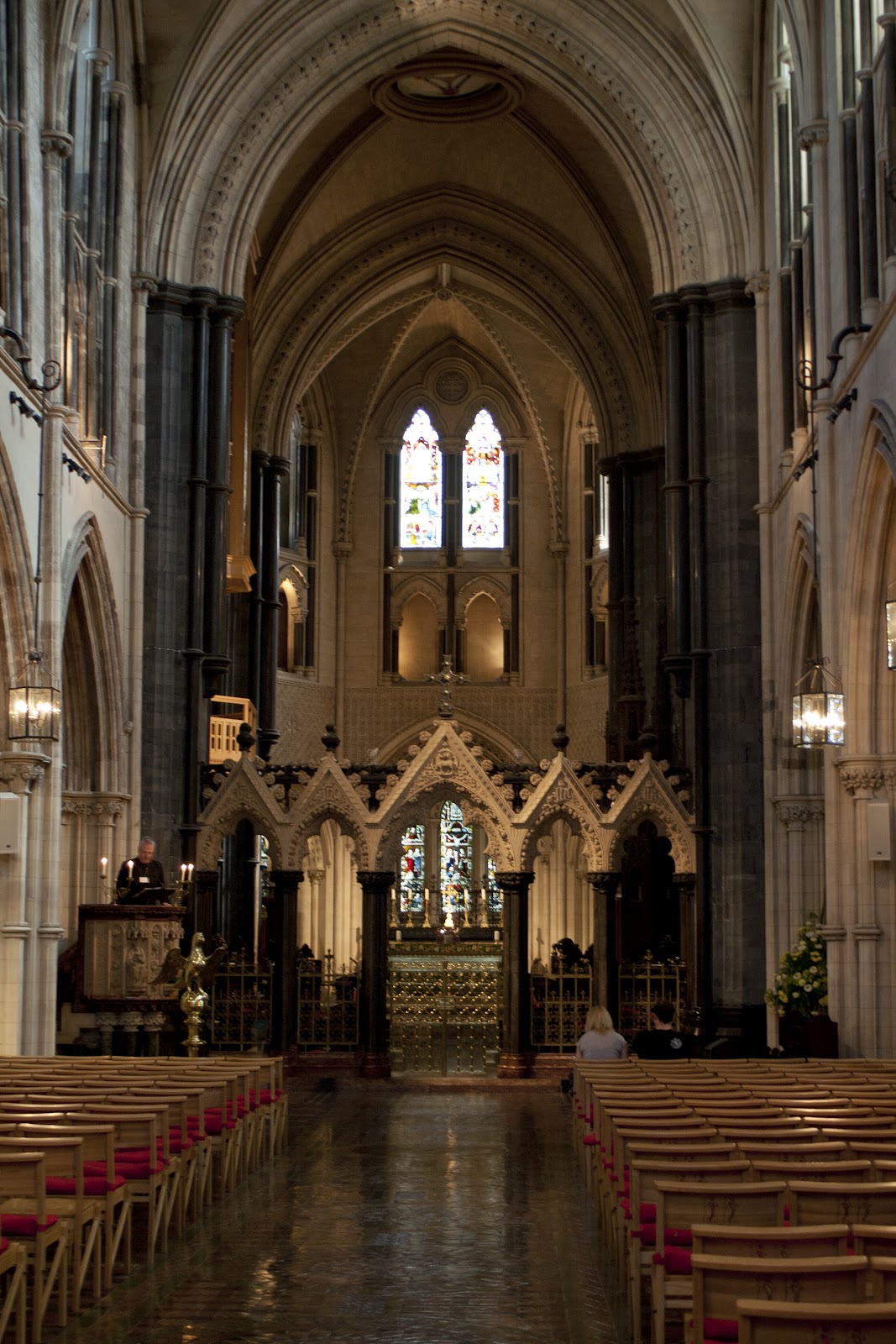
Visited St. Audeon and Christ Church whic is the cathedral of the United Dioceses of Dublin and Glendalough and the cathedral of the Ecclesiastical province of the United Provinces of Dublin and Cashel in the Church of Ireland. Founded probably sometime after 1028 when King Sitric Silkenbeard, the Hiberno-Norse king of Dublin made a pilgrimage to Rome.
In the 1180s, Strongbow and other Norman magnates helped to fund a complete rebuilding of Christ Church, initially a wooden building, in stone, comprising the construction of a choir, choir aisles and transepts, the crypt and chapels to St. Edmund and St. Mary and St. Lô.
The cathedral was the location of the purported coronation, in 1487, of Lambert Simnel, a boy pretender who sought unsuccessfully to depose Henry VII of England, as "King Edward VI".
In 1493, the choir school was founded. In 1539, King Henry VIII converted the priory to a cathedral with a dean and chapter and worked to ensure Christ Church adhered to his new church structure. His immediate successor, Edward VI of England, in 1547, provided funds for an increase in cathedral staffing and annual royal funding for the choir school.
The cathedral was extensively renovated and rebuilt from 1871 to 1878 by George Edmund Street, with the sponsorship of distiller Henry Roe of Mount Anville.


Christ Church also contains the largest cathedral crypt (63.4m long) in Britain or Ireland, constructed in 1172-1173. Having been renovated in the early 2000s, it is now open for visitors.
The crypt contains various monuments and historical features, including:
- the oldest known secular carvings in Ireland, two carved statues that until the late 18th century stood outside the Tholsel (Dublin's medieval city hall, which was demolished in 1806)
- a tabernacle and set of candlesticks which were used when the cathedral last operated (for a very short time) under the "Roman rite", when the Roman Catholic king, James II, having fled England in 1690, came to Ireland to fight for his throne and attended High Mass in the temporary restoration of Christ Church as a Roman Catholic cathedral.
- the stocks, formerly in Christ Church Place, made in 1670 and used for the punishment of offenders before the Court of the Dean's Liberty (the small area under the cathedral's exclusive civic authority), moved here in 1870
- historic books and altar goods of the Cathedral
- "The Cat & The Rat" are displayed with an explanatory note (and I will leave it as a surprise ;) )


Costumes from the TV series "The Tudors"
Then we walked to St.Patrick cathedral, ate in the adjacent park a delicious toast and the rain caught us for the last time and the first and last thunder announcing it.
We visited the castle (http://www.dublincastle.ie/) to stay dry and by the time we were done the sun would have shined again =)
St. Patrick's cathedral and storm coming
 The building actually is not very "castlely", it's more a palace. It was until 1922 the seat of British rule in Ireland, and is now a major Irish government complex. Most of it dates from the 18th century, though a castle has stood on the site since the days of King John, the first Lord of Ireland. The Castle served as the seat of English, then later British government of Ireland under the Lordship of Ireland (1171–1541), the Kingdom of Ireland (1541–1800), and the United Kingdom of Great Britain and Ireland (1800–1922). Upon establishment of the Irish Free State in 1922, the complex was ceremonially handed over to the newly formed Provisional Government led by Michael Collins.

Originally built as a defensive fortification for the Norman city of Dublin, it later evolved into a royal residence, resided in by the Lord Lieutenant of Ireland or Viceroy of Ireland, the representative of the monarch. The second in command in the Dublin Castle administration, the Chief Secretary for Ireland, also had his offices there. Over the years parliament and law courts met at the castle before moving to new purpose-built venues. It also served as a military garrison. Upon formation of the Free State in 1922, the castle assumed for a decade the role of the Four Courts on the Liffey quays which had been badly damaged during the Civil War.
It was decided in 1938 that the inauguration of the first President of Ireland, Douglas Hyde would take place in the castle, and the complex has been host to this ceremony ever since. The castle is also used for hosting official State visits as well as more informal foreign affairs engagements, State banquets, and Government policy launches, as well as acting as the central base for Ireland's hosting of the European Presidency approximately every 10 years.


;)
Here you have a map of Dublin:


Last night in Ireland, last absurd pizza and after few hours we were up 3.30 a.m. to take the same taxi we got arriving in Dublin, and on the plane with full eyes, mind and heart!
I hope you got at least a tenth of what was this great holiday to us!


venerdì 5 ottobre 2012

Ireland: chapter IV

Day 9, August 16th
Here and there in Connemara and the Sky road.
Starting from Galway we had an idea of Connemara. First we stopped in Coral Beach, what an amazing place. The sand was made by these little pieces of corals: white, red, orange. Sun was shining, only thing that kept us off the water was the really really strong wind!

 Then on the famous Sky Road, I suggest bike tours over there. Final visit of the day was at Kylemore Abbey and gardens (http://www.kylemoreabbey.com/).
The mountainous valley around Kylemore is an area of old oakwoods which terrace the mountainside. As the story, and wikepedia, goes: Kylemore Castle was built as a private home for the family of Mitchell Henry, a wealthy doctor from London, whose family was in textile manufacturing from Manchester, England. He moved to Ireland, when he and his wife, Margaret, purchased the land around the Abbey and became a politician, and was also an MP for County Galway from 1871 to 1885. The castle was designed by James Franklin Fuller and Ussher Roberts. Construction first began in 1867, and took one hundred men four years to complete. The castle covered approximately 40,000 square feet (3,700 m2) with over 70 rooms and the principal wall was two to three feet thick. The facade measured 142 feet (43 m) in length and is made of granite brought from Dalkey by sea to Letterfrack and limestone from Ballinasloe. There were 33 bedrooms, 4 bathrooms, 4 sitting rooms, ballroom, billiard room, library, study, school room, smoking room, gun room and various offices and domestic staff residences for the butler, cook, housekeeper and other servants. Several other building including a Gothic cathedral and family mausoleum containing the bodies of Margaret Henry, Mitchell Henry and a great grand nephew.
The Abbey remained in Henry's estate after he returned to England, and the castle was sold to the Duke and Duchess of Manchester in 1909, they resided there several years, before being forced to sell the house and grounds due to gambling debts. In 1920 the Irish Benedictine Nuns purchased the Abbey castle and lands after they were forced to flee Ypres, Belgium during World War I. Previously the nuns, who had been based in Ypres for several hundred years, had been bombed out of their Abbey during World War I. The nuns continued to offer education to Catholic girls, and opened an international boarding school and established a day school for local girls. They were forced to close the school in June 2010.
The Estate includes large walled Victorian Gardens, which have been open since the 70s, to public tours and 'nature' walks. The Benedictine community have restored the Abbey's gardens and Cathedral with donations and local artisans, in order to be a self-sustaining estate.

 Driving back in Galway enormous black clouds came in and just a moment befor the rain became to fall down heavily we had the luck to get a famous double raimbow from Connemara, huge and complete : D
Second night in Galway.


Day 10, August 17th
At  Clonmacnoise
Leaving Galway for Culain Mhic Nois - Clonmacnoise: founded sometime between 545 and 548 by Ciarán Mac a tSaor, a young man from Rathcroghan, Co. Roscommon. Until the 9th century it had close associations with the kings of Connacht. The strategic location of the monastery helped it become a major centre of religion, learning, craftsmanship and trade by the 9th century and together with Clonard it was the most famous in Ireland, visited by scholars from all over Europe. From the ninth until the eleventh century it was allied with the kings of Meath. Many of the high kings of Tara and Connacht were buried here.


 Next was Newgrange. A prehistoric monument located in County Meath, on the eastern side of Ireland, about one kilometre north of the River Boyne. It was built around 3200 BC, during the Neolithic period. There is no agreement about what the site was used for, but it has been speculated that it had some form of religious significance because it is aligned with the rising sun, which floods the stone room with light on the winter solstice. Which should be such spectacular to watch! Thing taht made me shiver: you walk in the hill and in the middle room the stones are the same, never been touched by anyone but the men that worked to build it up!wow...

Last stop of the day was Monasterboice, in the cemetery and around the Church there is a roundtower and three Crosses of the most important founded in Ireland. Nobody was around but if you're passing by I would definitively suggest a quick visit.

Then we landed in Dundalk in a verly lovely B&b, little note: under the heavier rain we got during the two weeks. Dinner in a pub with great music aired on the radio (a change, nobody playing live!) then bed time!


Day 11, August 18th
Drove to Belfast and did a tour of the murals, with a guy explaing you while getting on and off the taxi (http://www.belfastmuraltours.com/ or http://www.belfastcitytours.com/ or you can find many others and decide once you're there). Well I think it was one of the most interesting thing we did. It was really strange to pass from a modern city centre to something totally different, two SIDES of the same city, "peace" walls between them. Really made me think how good ideas andideals may become ideologism (I hope that you can understand what I'm trying to say, pretty difficult to explain in a foreign language) in time.
Lunch and then walked around the city, to the port and to the mall where we left the car. Pretty much bought an entire soda machine to use all the English money we had :P
Dined in a place in the centre of Dundalk after Mass.


lunedì 1 ottobre 2012

Ireland: chapter III

A good sleep and again on the road after two (uoo) days in the same place. First stop of the day was in Adare, famous fot the cottages but also for the Augustinian friary. The Earl of Kildare founded it, we're talking of County Limerick in 1315. It was known as the Black Abbey due to the colour of the friars’ habit. Religious activities continued for about 200 years, until the community was suppressed in the mid-16th century. Today, visitors can view the well-preserved cloisters as well as the church, in use by the Church of Ireland since 1807. Also not to be missed are the Quin and Dunraven families’ mausoleums.


Then the road brought us to the cliffs of Moher. Well if you ask me a little too crowded but definitively worth the ride! What a place, even with my mum screamin "off the edgeeee!"
An Angelito (see photo below) with chocolate stick going a little back to Lahinch where my sis, bro and I dived into the ocean (God, it was cold!!) playing with the waves.
The Angelito

Then we headed to Doolin where we where to stay for the night. What a place this little place of Clare! :)
Dinner at McDermott's Pub and "tourist" session by local musicians. Met again an italian guy we first met in Kilkenny, on a trip with his motorcycle!


 Day 7, august 14th
Aran islands day! i have to say it was like a dream come true for me. It's a few years I'm saying -I want to go there sooo badly- And it couldn't be possibly better. We left under a raimbow and clouds and landed on the main island (Inishmore) with a bright and warm sun!
Hired a bike (it's the best way to visit the island, you can cycle it all and reach places on foot) and then to Dún Aonghasa (Dún Aengus),  the most famous of several prehistoric forts on the Aran Islands of County Galway, Ireland. At the edge of an 100 metre high cliff.
A popular tourist attraction, Dún Aonghasa is an important archaeological site that also offers a spectacular view. It is not known when Dún Aonghasa was built, though it is now thought to date from the Iron Age. It was surmised that it was built in the 2nd century BC by the Builg following the Laginian conquest of Connacht.
Dún Aonghasa has been called "the most magnificent barbaric monument in Europe." Its name, meaning "Fort of Aonghas", refers to the pre-Christian god of the same name described in Irish mythology, or the mythical king, Aonghus mac Úmhór.
It was just the perfect day, pics says it better ;)
Ferry back and trought the Burren to arrive on Galway, in the best apartment we got during the holiday! Pasta with smoked salmon at "home" :)


Day 8, August 15th
Medioeval Galway
Galway visit with the walking tour guide. This is a nice thing to do all over Europe in the most important city. There are these groups gathering and starting the tour at a certain time, you go around the city to see the musts and you also get to know other travellers. Then you pay your guide in a "tip" form of payment, for what you think it was worth! We did it in Galway and also in Dublin, two different companies.
Under an occasionally (intense!) shower we visited the city and then ate at the Mc Donagh's Fish & Chips (so good!) and then we had a walk by ourselves and went to Mass for the The Feast of the Assumption of the Blessed Virgin Mary. Ice cream (italian!) and then at the King's Head, famous pub in the centre, for some good music and dancing!

port with Spanish Arch on the left

mercoledì 26 settembre 2012

Ireland, Chapter II

Day 3, August 10th

The Rock of Cashel (Irish: Carraig Phádraig), also known as Cashel of the Kings and St. Patrick's Rock, is a historic site located at Cashel, South Tipperary, Ireland.
Along the day we learned more about the Butler family, it was like the red line of the first days of our staying in Ireland.

According to local mythology, the Rock of Cashel originated in the Devil's Bit, a mountain 20 miles (30 km) north of Cashel when St. Patrick banished Satan from a cave, resulting in the Rock's landing in Cashel. Cashel is reputed to be the site of the conversion of the King of Munster by St. Patrick in the 5th century.
Rock of Cashel, roundtower and church ruins
The Rock of Cashel was the traditional seat of the kings of Munster for several hundred years prior to the Norman invasion. In 1101, the King of Munster, Muirchertach Ua Briain, donated his fortress on the Rock to the Church. The picturesque complex has a character of its own and is one of the most remarkable collections of Celtic art and medieval architecture to be found anywhere in Europe. Few remnants of the early structures survive; the majority of buildings on the current site date from the 12th and 13th centuries.
Infos: http://www.heritageireland.ie/en/south-east/rockofcashel/

The village itself it's pretty nice and worth a stop. We had lunch in this cozy place just under the rock itself,
near the car park, "Granny's kitchen":


Then we headed on to Cahir and visited the castle (http://www.heritageireland.ie/en/south-east/cahircastle/) one of the largest castles in Ireland, is sited on an island in the river Suir. It was built in 1142 by Conor O'Brien, Prince of Thomond.
Panorama from the chemin de ronde of Cahir castle
Cahir castle
At the end of the day we arrived in Cork, second largest city of Ireland, grabbed a burger at Burger King and the a good old creamy Guinness in a truly magical spot near our B&b, not the classical Irish pub, it was more like a place where time was still in the '800, Paris-retrò style.


Day 4, August 11st
Classy Irish Full breakfast (gives you strenght) and off to visit the city: Saint Fin Barre's Cathedral, worth a visit, with all the story of the first construction and then in 1863, another cathedral was the first major work of the Victorian architect William Burges.The style of the building is Early French, in fact seemed to me I had been kicked all the way to France for half an hour!
After that, the English market, where we got our lunch for later on and a delicious juice at the Fruit Boost.
I didn't have such a good impression from Cork, it's a big city for Irish standards, but I think it has little "human dimension", less than Dublin.


Then we drove to the Blarney castle and gardens, started showering so we put our k-ways on to stand in the queue, the longest one we met in this travel of ours...and all this, to kiss a stone(it's supposed to give you the git of eloquence tought) ! -.-
Anyway we did kiss the stone, visited a few gardens. Quick lunch in the parking lot. In the late afternoon we got in Killarney, well not in the city. We stayed in the "Killarney Inn", which was very very comfortable.

Blarney castle
People kissing the stone
IRN-BRU!!From Scotland with love =)


Just the time to leave the luggages and then whe went to Killorglin, risking our lives along the way (surprisingly not our driver's fault due to unexpierence but a local just didn't see we were on the road :o ) . The city is located on the river Laune, which has a rowing club and a new boathouse. Lucky enough those were the days of the famous Puck Fair and we had a taste of that, also meeting one of the guys selling bracelets and things who lived in Italy for about 6 or 7 years and was a teacher here too!
Then little beer at the Inn before bed time..

This is not taken by me, but just to give you the idea of what the Puck fair looks like. In the tower  the King of Pucks will be placed later on...


Day 5, August 12nd
Ring of Kerry day!
First stop: Rossbeigh Beach, beautiful beach, in a bay...I wanted so badly to dive in but we didn't remember to bring swimsuits with us! Risked the already operated- knee sliding on the seaweeds which I didn't recognize because I'm used to the Mediterranean ones :(


Second stop: Cahergal Stone Fort. It is a large Staigue-type fort (one of the many Iron Age forts) with the lintelled entrance in the south- east. It is found close to Ballycarbery Castle, near Cahersiveen County Kerry. The interior walls of this ancient Stone Fort have stone stairs and there is a rectangular house within the fort. The walls of the fort have been reconstructed and now stand about 2m high for the most part. The walls are about 5m thick at the base. I think these stone forts are pretty amazing and fascinating!
Eating castles


Third stop: lunch, can't remember the name of the village, anyway only the time to order something in a pub and then we were off to the

Fourth stop: somewhere over the fog and Fifth: Ladies View, a scenic point along the N71 portion of the Ring of Kerry, in Killarney National Park, Ireland. The name apparently stems from the admiration of the view given by Queen Victoria's ladies-in-waiting during their 1861 visit.
Then we went in Killarney to buy something to eat for dinner at the Inn, after dinner we watche the Olympics closure ceremony =) Olympics had, until then, been like the frame of our journey with Katie Taylor winning the gold, and other box matches, us trying to get news of Italian athletes and so on.

Ladies view
And this, is just an amazing truck/jeep/mean of transport we saw in Cahir and wish I had it ;)

End of chapter II